
Skip to content

The right software starts before the build.

I learn how your operation really works, find the friction worth solving, and shape software that fits the people, systems, and constraints already in place.

Twelve years across government finance, credit unions, and fintech — from discovery and systems design through implementation, quality, and handover.

Nathanael Toussaint
Nathanael Toussaint Discovery → systems design → reliable delivery
  • 12+ yearsAcross public-sector, financial, and SaaS environments
  • 7 organisationsFrom Dominica government and credit unions to fintech
  • One broad career arcTeaching, engineering, QA, product, and solution consulting
  • Operational softwareBuilt around real workflows, constraints, and hand-offs

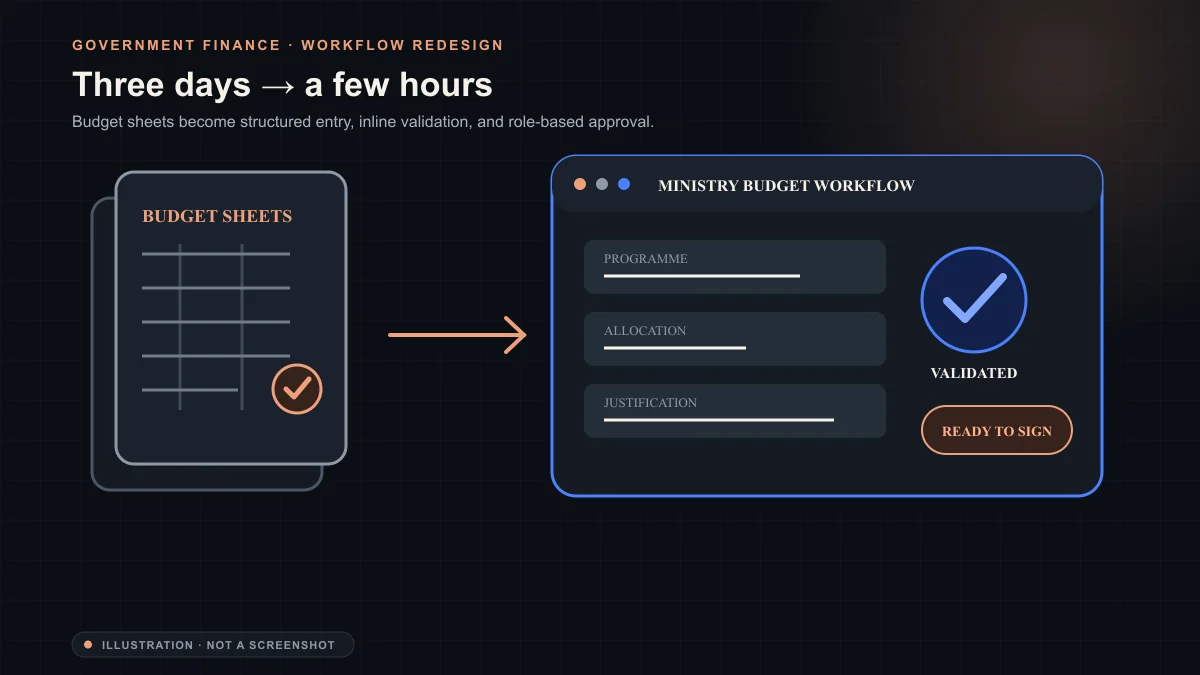
Three days of import corrections became a few hours of error-free import.

The bottleneck was not budget preparation itself, but the correction loop before data could be imported. The application moved validation earlier in the workflow so the final import could run cleanly in a few hours.

Illustration of budget sheets becoming validated digital fields and an approval workflow for the GOCD Budget Web Application

Before3 daysAfterA few hours

GOCD Budget Web Application

Built a browser-based budget application that allowed ministries to log in and enter account records, with validation and approval built directly into the workflow for budget approvers. This replaced emailed files with a proper flow from data entry through validation and approval. The game-changer was the final stage: data import and report generation were brought into one reliable workflow, backed by a reliable database as the single source of truth.

  • ConstraintEmailed files and import-blocking errors
  • InterventionStructured entry, validation, imports, reports, and printing
  • ResultThe completed-budget import, report-generation, and printing stage fell from three days—mostly spent correcting errors that blocked imports—to a few hours, depending on import volume.
Read the case study

Understand first. Frame the right intervention. Then deliver.

Discovery and ideation carry the most weight because a well-built answer to the wrong problem is still the wrong answer.

  1. 01

    Discover and understand

    Learn the operation, people, constraints, incentives, data, and real source of friction.

  2. 02

    Frame and ideate

    Shape the right intervention before committing time and budget to a build.

  3. 03

    Prototype and align

    Make the workflow tangible and confirm it with the people who will use it.

  4. 04

    Build and validate

    Ship in useful increments, with testing integrated throughout delivery.

  5. 05

    Handover and support

    Document, transfer knowledge, observe the solution in use, and stay available.

Quality runs through the work

From framing through prototype, build, handover, and support, assumptions are tested and the solution is validated continuously — QA is not a gate attached at the end.

02 — 03 — 04 — 05

You do not need a finished specification to start.

Bring the workflow, constraint, or stubborn workaround. We can discover what the right solution should be together.

Talk through the problem